It had never once looked at the animal.
AI
Your AI model learned the
snow, not the wolf
Olivier Drybooms & Jan Moons 14 Octobre 7 min read
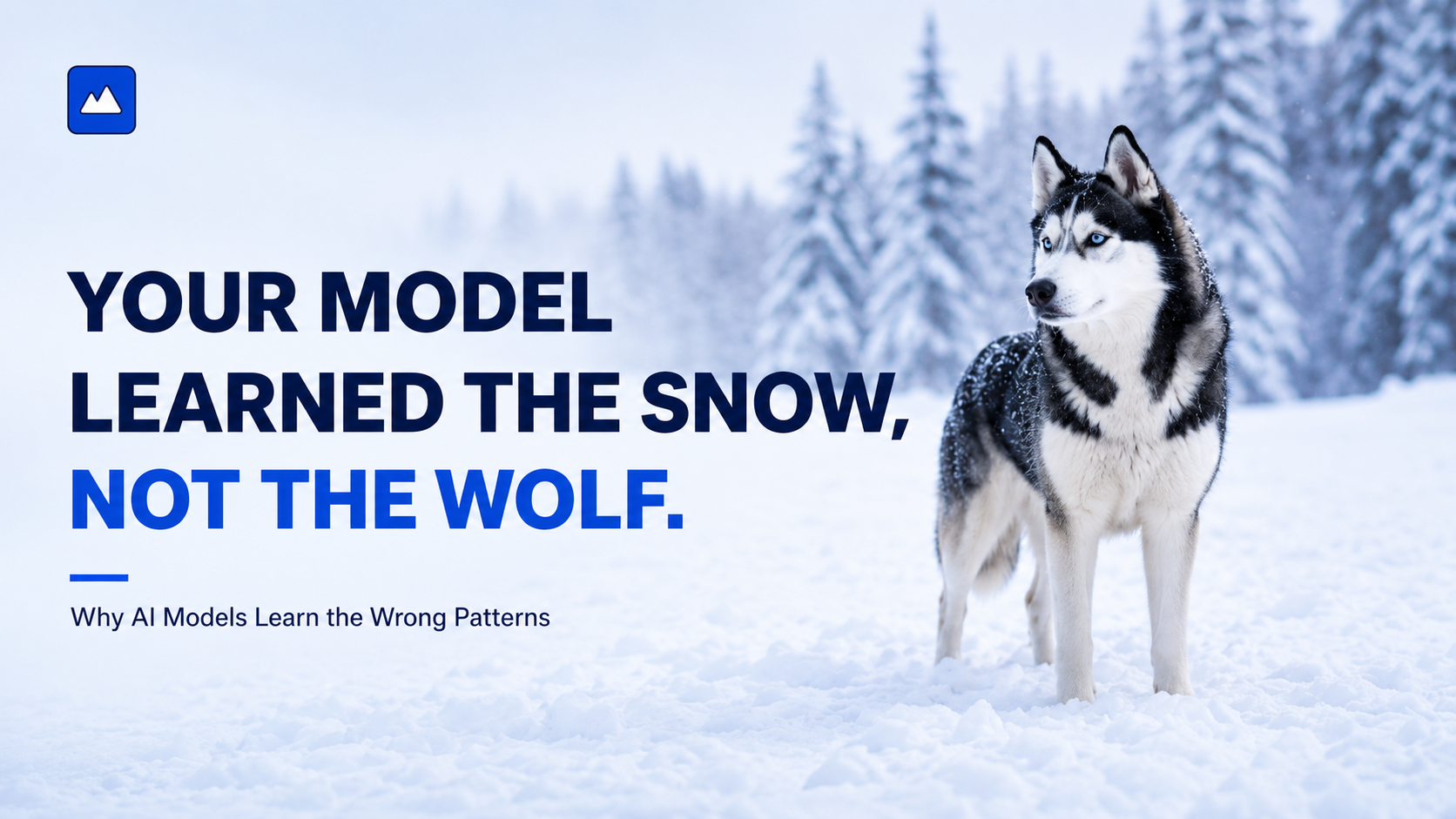
Researchers built a model to tell wolves from huskies and gave it a flaw on purpose: every wolf photo they trained it on had snow behind it, and not one husky photo did. Then they asked
people who knew machine learning whether they trusted it. More than a third did. Only when they were shown which parts of each photo the model was looking at did almost all of them see the problem: the model had never looked at an animal. It looked at the snow.
Nothing in its answers gave it away. So what would? AI models learn the wrong patterns because that is what a model is for: it splits two groups of photos by whatever separates them most cleanly, and snow separated them cleanly. The researchers caught it by making the model
show its working. The cheaper check comes earlier, in where the data came from.
What did the model actually learn?
It learned the background. Snow was the most consistent difference between the two piles, so snow is the rule it found, and the animals were beside the point. None of that is a malfunction, which is the uncomfortable part.
That is the shape to look for. The thing you wanted to detect happened to travel with something in the background, and in the case of the wolf, the background was the easier signal to pick up.
Why didn’t the score
give it away?
Because from where the model sits there is no decision to notice. A model detects what is statistically consistent and it never asks why a pattern exists, so a pattern holding across every example in the set is precisely what it is hunting for.
AI looks a great deal like understanding from the outside, and that is what makes this so hard to keep hold of. Image recognition feels like seeing, and it’s matching patterns of pixels against labels picked up from millions of earlier examples. Spotify doesn’t know your taste in music. It knows that people who play what you play also played this, which is a less flattering thing to be told and a more accurate one. Your spam filter doesn’t recognise bad intentions. It recognises subject lines,
sender metadata and writing style that resemble spam it has seen before.
None of them reads meaning. Garbage in, garbage out is the older phrase for it, and it hasn’t been improved on.
Where does the snow
get into the data?
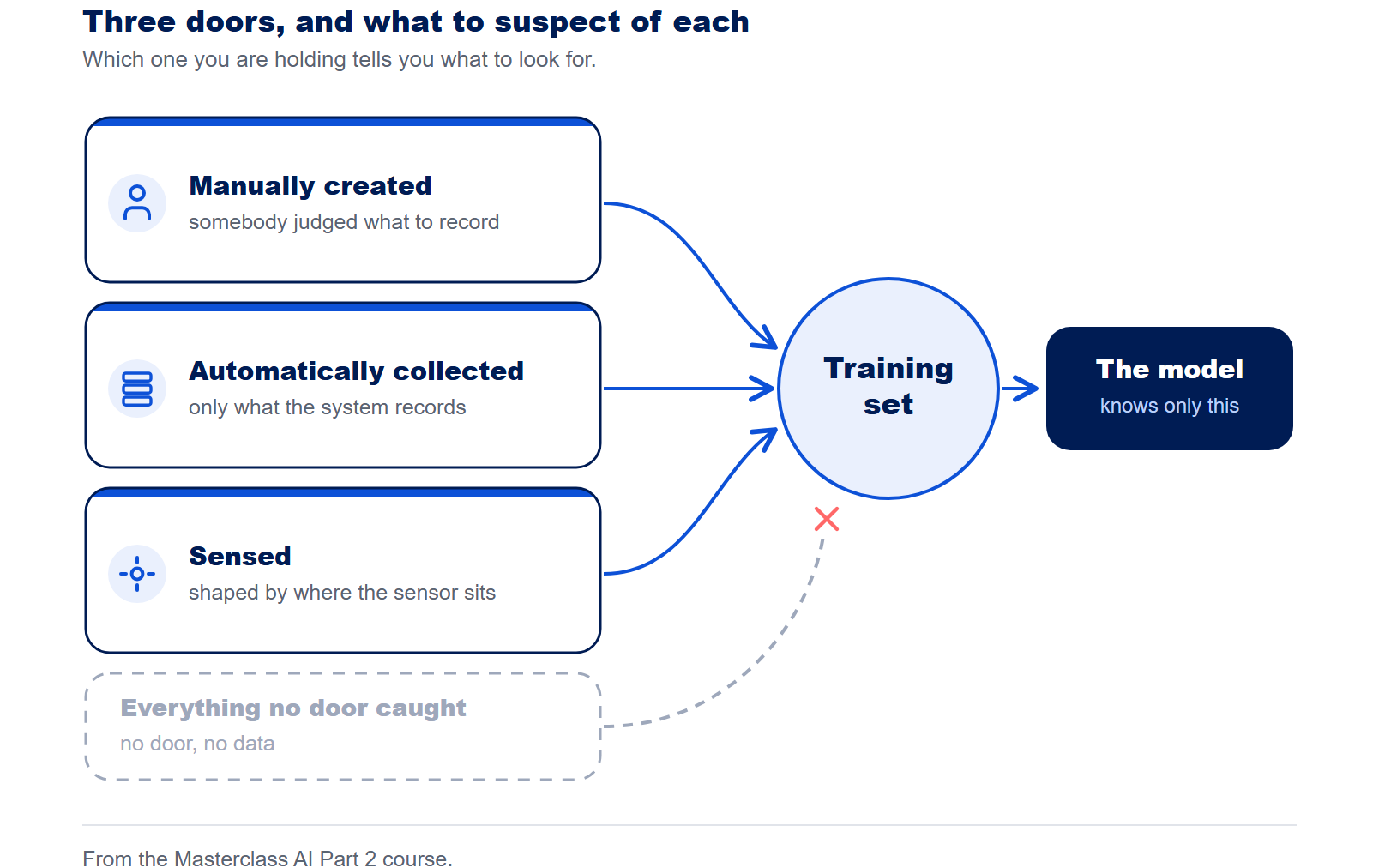
At collection, nearly always, and long before anyone opens a modelling tool. The snow didn’t arrive during training. It arrived with the photographs, in somebody’s choice of which pictures went into the pile. Training data comes from three places, and which one you’re holding tells you what to be suspicious of.
- Manually created. Typed in by people. Every entry has already passed through somebody’s judgement about what was worth writing down and how to word it.
- Automatically collected. Captured in the background by systems, which is what makes it scale so well. It records what the system was built to record, and nothing else.
- Sensing the environment. Raw and rich, and shaped by where the sensor sits, what it points at and when it happened to be running.

Whichever of the three sources you have in front of you, the question is the same. What else came along for the ride, next to the thing you actually wanted to measure?
Would a bigger model have caught the snow?
No, and it would have buried the mistake deeper. Traditional machine learning models, a decision tree or a regression model, are white or grey boxes: you can trace a prediction back a step at a time and see what the model did and why. Neural networks are black boxes. You can see what
goes in and what comes out, but explaining the route between them is hard.
That isn’t an argument against neural networks. They’re the reason we have image recognition, speech and language generation at all, and they get there by working out for themselves what to look at without a human pointing first. Transparency is what you pay for it.
The consequences aren’t theoretical. In parts of the United States, algorithms have been used to help judges decide whether someone is held or released before trial. One of them, COMPAS, assigns a risk score based on things like criminal history, age and postcode. The algorithm isn’t transparent, and investigations have shown it can be biased, in particular against Black defendants.
A snow-shaped error in a decision tree is findable. The same error inside a deep network may sit there quietly until the model is running on data that doesn’t happen to share the flaw.
That isn’t an argument against neural networks. They’re the reason we have image recognition, speech and language generation at all, and they get there by working out for themselves what to look at without a human pointing first. Transparency is what you pay for it.
The consequences aren’t theoretical. In parts of the United States, algorithms have been used to help judges decide whether someone is held or released before trial. One of them, COMPAS, assigns a risk score based on things like criminal history, age and postcode. The algorithm isn’t transparent, and investigations have shown it can be biased, in particular against Black defendants.
A snow-shaped error in a decision tree is findable. The same error inside a deep network may sit there quietly until the model is running on data that doesn’t happen to share the flaw.
What do you check before you trust the output?
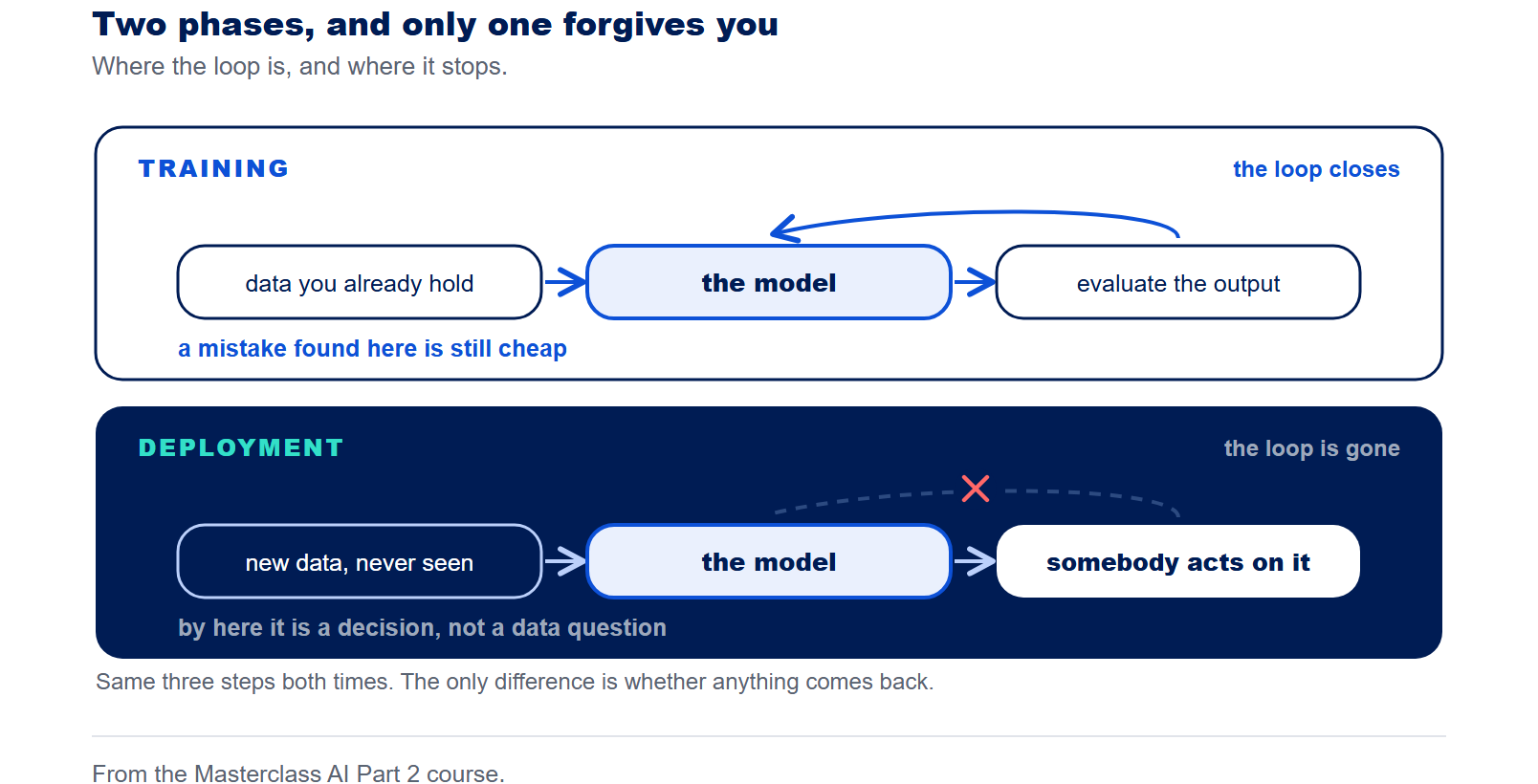
Check it in training, while it’s still cheap. A model has two phases and they are not equally forgiving. In training it learns from data you already hold, and the output is there to be evaluated, validated and adjusted against. In deployment it runs on new data it has never seen, and by
then a misleading signal has become a decision somebody acts on.

So here is the exercise. You’re building a model to predict which customers will renew their contract. You have CRM notes, a few spreadsheets and some customer ratings. Two questions:
- What hidden signals could be misleading your model?
- How would you tell whether it’s really learning the right thing?
Nobody can hand you those answers, because they live in your data rather than in anybody else’s. What is fixed is where to look: upstream of the algorithm, every single time, and upstream is the part people skip.
Does clean data make
a block box readable?
No. You can check your inputs properly, ship the model, and still be unable to explain one particular decision to a customer, an auditor or a regulator. Data quality sits upstream of the transparency problem. It doesn’t stand in for it.
It doesn’t scale evenly either. Reading a spreadsheet is an afternoon. Checking eighty thousand photographs or free-text tickets for a signal nobody has thought of yet is a different kind of job, and unstructured data is around 80% of what is out there and growing about three times
faster than the structured kind. Masterclass AI – Part 2 on The Master Channel takes apart how a model is built, and where along the way a flaw like the snow can slip in.
What this article should change is the question you ask first. Next time a model gives you a number you’re pleased with, don’t start with how good the number is. Ask what else was in the data that could have produced the same one. Often there’s nothing there. Sometimes there’s snow.
Find out where else the snow hides
Dig deeper into the snow in Masterclass AI – Part 2: A deep dive into how it works. It picks up where this article stops: from the input data through to the model architectures, so you can see where inside a model a mistake like this one has room to hide.
Training a team, or want more information on how to get started with The Master Channel? We’re happy to help!
© The Master Channel 2026